AI agents and more: How tech DNA powers Piping Technology & Products
CEO Rakesh Agrawal is equal parts technologist and industrialist — and having a blast leading 700 employees at Houston’s stalwart manufacturer
By Bart Taylor
Rakesh Agrawal leads the company his father founded in the mid-1970’s, “growing up in the business on my dad’s knee,” he told me in a recent conversation.
Rakesh’s dad, Dr. Durga Agrawal, parlayed an interest in designing piping systems to a side hustle while earning a PhD at the University of Houston, becoming a self-taught expert in pipe stress analysis. “He’d go out to Shell Deer Park and other chemical plants along the ship channel and, well, help them solve piping problems,” Agrawal says. “People started asking for more. ‘You’re recommending we put these pipe supports or expansion joints into the piping system. Would you supply those to us?’” he recounts with a smile. “So we eventually started our own manufacturing.”
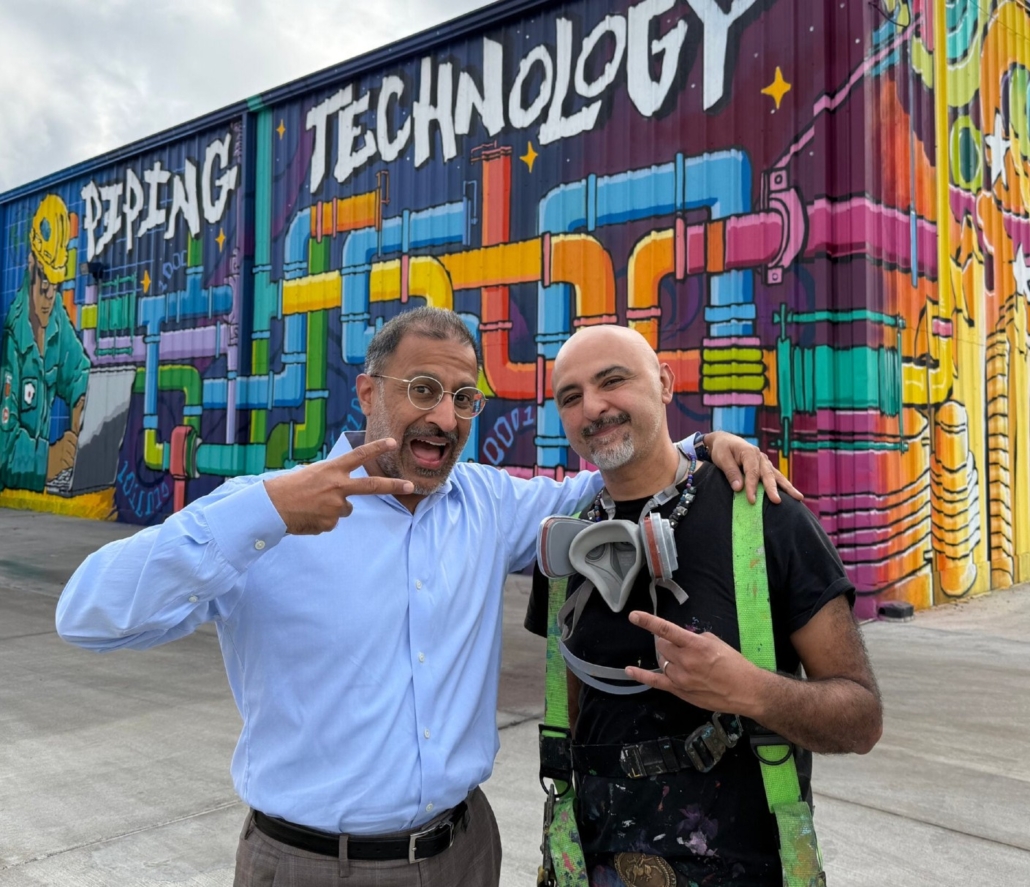
Good thing for Houston. Today the company boasts a workforce of over 700 employees, 400-plus in manufacturing, in 500,000 square feet of covered shop space with 75,000 more on the way as part of a major expansion. The company is building on its 40-acre site at the junction of Highways 288 and 610 – notable by a colorful GONZO247 mural that drivers see every day.

But it’s also the talent mix at PT&P that’s noteworthy – shaped by its tech DNA. “Everything is engineered to order, built to order,” Agrawal says. “We do what could be called ‘mass customization’, where we make a quantity of product, but all different based on the customer’s application. So half of the work we do is engineering, and the other half we do is manufacturing,” he explains. “We’re a mix of knowledge workers – programmers, engineers, buyers and more – and craftspeople – welders and technicians that operate various CNC machines or forklifts.”
It’s a symphony of talent focused on designing and manufacturing products to solve piping system challenges like thermal expansion and contraction, vibration control, and energy containment, in a mass customization model.
The markets PT&P serves are self-evident – but changing, something that we write about every month, it seems. “I think there was a time when oil and gas was 70 or 80% of our business, but we’ve always been diversified. It’s how we survived the crash in oil and gas in the ‘80s while many did not,” he says. “In the last few years, we’ve expanded to selling to mechanical contractors as we do a great deal more work in data centers, pharmaceuticals, and automotive. Data centers, in particular, are a big driver in our business right now.” (For Agrawal and other Houston manufacturers, as we’ve reported.)
The PT&P story today is about what they make and how they’re doing it — and how the company is navigating a technology journey that for many, can be a challenge. PT&P is a manufacturer — and also a tech lab, including the use of AI agents.
I asked where it began. “It started 30-plus years ago. I studied mechanical engineering and computer science, and got two degrees at Rice University. Mechanical engineering is where I grew up, right?, the son of an engineer. When we had a flat tire, it was like, ‘oh, we’re gonna do a soap and bubble test on the tube’,” he laughs. So I grew up around the practice of mechanical engineering, and computers were my hobby, and I was very lucky to have parents who indulged my curiosity in computers. There was always a new computer at the house,” Agrawal says.
“And even at the business, we were always employing technology. I had just finished college, and my first job was building the company’s software systems. We’re in a business where traditional ERP doesn’t really suit us very well because of the mass customization thing I mentioned. ERP likes it when you’re making the same thing over and over again – for example, if you’re making a million AirPods and they’re all only slightly different from one another,” he says. “But in our business you lose your mind trying to use a traditional ERP. So I hired a few friends from Rice, and we built a custom ERP from scratch – and it became the technology core of the company.”
Agrawal actually left the company for a time to scratch his technology itch. “I started a software company, SnapStream, and, as an investor, I built a portfolio of software. SnapStream enables media companies like New York Times, the Daily Show and Colbert, before they went off the air, to source all their short video clips,” he says.
But I had called Agrawal to chat about an AI case study I’d read — at Tasklet that featured PT&P — where his team is using AI agents to enhance productivity. “I started a group within the company two years ago to attempt to drive broader usage of AI at the company. We paid for people’s ChatGPT accounts, and there were good ideas and people were inspired by one another. But it kind of ‘hit a wall’ in terms of broader usage,” he says.
“Then I was introduced to this AI agent technology, Tasklet, through a venture fund I’m an investor in – and they had automated their entire backoffice using it,” Agrawal says.
AI agents abound. Tasklet says its “AI command center…takes ownership of work: it sends emails, updates spreadsheets, files tickets, builds apps, and runs recurring processes across your tools. Describe the outcome in plain English, and Tasklet figures out the rest.” In other words, give your agent the keys to your productivity or process apps, and it organizes your world and improves the processes and tasks in front of you. Its use cases span the operational spectrum of any business, it seems, including shop-floor employees at PT&P.
For his part, Agrawal uses a personal “Chief of Staff” agent connected to 22 services — Gmail, Google Analytics, Google Chat, calendars, and others.
It’s a leap of faith I haven’t yet taken. Agrawal can relate, to a degree. “People have old information,” he says. “They read a headline where OpenClaw came out earlier this year and it drained someone’s bank account. The fact is that these agents have guardrails on them. Sure, they can make mistakes — but generally the mistakes are pretty bounded.”
His employees provide much-needed context. “One of the people on my team — shoutout to Fiona — calls these AI agents ‘genius math babies’,” he laughs. “There’s this weird dynamic where AI is really good at just, like, ridiculously hard things, but then really dumb when it comes to really easy things. Genius math babies. We need to learn how to use them to get work done accurately, to be effective but not drain our bank accounts!”
For Agrawal, his people also provide the ‘true north’ for his company’s tech roadmap. “I kind of think about AI agents as a new productivity primitive. It’s like a spreadsheet or a word processor, and I want us to hurry up and learn how to use word processors and spreadsheets so we can all be more productive.”
Agrawal also acknowledges that the technology he’s harnessing may profoundly impact his workforce – every workforce. I get around to asking what impact this technology will have on jobs. “The job’s question is a hot topic when you talk to people in the AI world. Nobel Prize-winning laureates are apart on the issue,” he says.
“My personal view is that, yes, at some point it’s going to be pretty bad and weird, at least before it gets better. And I see it as my job as the CEO of this company to prepare our workforce and our company for whatever’s next, that next level where new jobs will be created — and get in front of it.”
Read PT&P’s Tasklet use-case study here. We’ll also circle back with Rakesh Agrawal and Houston’s powerhouse manufacturer in later editions. There’s a lot more.
Bart Taylor is president of the Greater Houston Manufacturers Association. Reach him at [email protected].