To know Dan Allford is to understand that if one person could personify Houston manufacturing, it’s him. Not that he would agree; too modest from too many years in the patch, for one.
But much like Houston, Allford and his company, ARC Specialties, is keeping one foot planted in the oilfield but the other in a new industry mix that includes “nuclear power, additive, defense, data centers, drill-ship automation, and others” as he told me recently. To any manufacturing industry where automation and robotics are involved, where the engineered industrial solutions his team manufactures are already in high demand.
Allford found manufacturing early, or it found him. “Both my parents taught at the University of Texas. My mom was a geneticist, and my father was an English professor. But when I was a kid, I built a steam engine, we built a computer terminal (which taught us how to program), a rocket engine – we had gasoline everywhere so we built a flamethrower – but nobody said ‘kid you’re an engineer.’ Instead, I looked at my parents and said, ‘well, if I’m not an English professor, I must be a geneticist,” he laughs. “I did finally spend a year in the biology department – and then I figured out that people will actually pay you to do the stuff I wanted to do.”
From there, Allford got busy. “I got an Associates Degree in welding from Texas State Technical College in Waco, then got a great job at Hughes Tool Company. The engineers there couldn’t program, so even though I was a technician, I wrote programs for the engineers. It was welding-plus-programming – pretty unique,” Allford recounts. “So Hughes put me through college – I got a Bachelor’s Degree from the University of Houston. But they didn’t have a place for me given the value of my credentials, so I started a little company called ARC Specialties.”
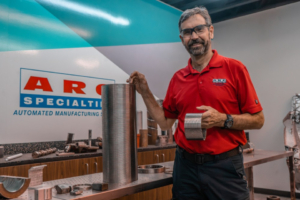
That was 1983. “My first job, this is crazy, was a hot tap at the plutonium plant in Idaho. As far as I know, there’s only one plutonium plant (in the US) and there’s a smokestack that’s a couple hundred feet tall. It’s 316 stainless (steel). It’s eight feet in diameter. It’s three-eighths inches thick, covered with four feet of concrete. And they wanted to bore a hole through the concrete from the outside and slide a pipe in,” he says, almost giddy in describing the project. “The welded pipe was a 10-inch pipe to the smokestack and you couldn’t weld the outside with all this concrete in the way. And so we welded the inside and then plasma-cut the wall out. They said, ‘don’t drop that slug because the machine at the bottom is still running!’ And so we had to hold the slug. But how do you hold stainless?”, he asks. “Can’t use a magnet. We used suction cup!
“So I built that machine back in ‘83 and it worked. If the government had known it was a kid in his garage, they might not have reacted well,” Allford smiles. “But nobody told them – and for us, we’re off to the races.”
After plutonium, I mentioned that a pivot to oil and gas was probably inevitable. “Well, yeah, just by proximity,” Allford responded. “And these are my people, right? These are folks I know. I’m in Houston, and Houston, particularly back in the ‘80s, was almost entirely oilfield.”
Like others, Allford knew what he was getting into. “I love the oilfield. It is great when it’s good and horrible when it’s bad. It’s an extremely cyclical industry. Oil’s at $100 a barrel. So that’s the good news and the bad news. This will create all sorts of chaos,” he mused. “And so I think I’m not the only one in the oilfield that recognized the fact we needed some diversity here in Houston. And so what I started to do was look for opportunities where we could take the technology that we developed here and apply it elsewhere,” he says.
Across industries, there are plenty of examples. “In the electric vehicle industry, they went from spot-welded sheet metal chassis to cast chassis. Well, when you make a casting, you have to trim it, and castings aren’t perfect; you have to trim off the risers, the sprues, the biscuit — and the technology we developed for plasma-cutting three dimensional parts in the oil field was perfectly suited for the EV industry,” he says. “But we needed somebody that would transition that industry from spot-welding to casting in order for us to use that technology. It was like serendipity, fortunately. We came together with the opportunity at the right time.”
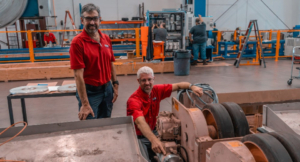
That said, Allford and ARC are creating their own opportunities and none more pronounced than the integrated robotic solutions his team is developing — in multiple industries. I asked about ARC’s robotics timeline, when it got started.
“Well, my definition of a robot is programmable, multi-axis, and autonomous. I get a lot of push back on that, but by my definition, there’s a lot (of implementations) that are not robots; they’re tele-operated,” he says.
“Back in the ‘80’s, when ARC Specialties was still ‘part-time’, I worked as a robot integrator, and in the robot industry, there’s something that separates the robot manufacturer from the end-user, and that’s an integrator. The end-user could integrate their own robot. On occasion, the robot companies take that on themselves, but that’s what they call the ‘last mile’ – the toughest part in robotics. Robots are a commodity. People have applications for them, but you have to tool them up and write the software.” he explains.
And Allford touched them all. “Back then, we had a lot of American robot companies. I was using Adept (Omron). I was using Cincinnati Milacron, as well as FANUC, and Daewoo. So that was all happening between ‘83 when I started the company and ‘90 when I decided to go full-time,” he says. “So I’ve been doing robots all the time, and it was a natural progression once I started ARC Specialties.”
Today, ARC’s robotics business seems to be the right solution, at the right time. Allford gets it. As he laughed to me, “in my twilight years, it’s good that it’s kind of coming together.” His client list takes him back to the oilfield, to offshore rigs in the Gulf, to a Naval contract involving submarines — and to industry opportunities poised to change Houston manufacturing. I asked about nuclear energy.
“Well, the nukes are fun, and I’ve been a big fan of nuclear power my whole life. I came close to going to work constructing nuclear power plants when I got out of school in ‘79. I’m glad I didn’t because the industry died for, you know, 30 years, but it’s back and it’s back with a vengeance,” he says. “There are currently 60 companies developing small, modular nuclear reactors right now. And these guys are scary smart when it comes to nuclear physics and such, but they lack two things. They don’t have the ability to do remote manipulation. And unless you want to send your kids into a radioactive zone, we need to send my robots.
“And the second thing they need is welding technology because you have to weld this stuff up.”
Feels like full circle for Allford and ARC. And again, he’s smart enough to know what he doesn’t know. “What I found is that I couldn’t even communicate with these guys; they’re so smart and specialized. So I actually joined the American Nuclear Society, and I took a week-long class. I’m now a certified nuclear guy! With a certificate on the wall. I had to just have the right vocabulary to talk to these folks. But it’s been fascinating and it’s exciting work because it’s dynamic, it’s well funded, and it’s absolutely essential.”
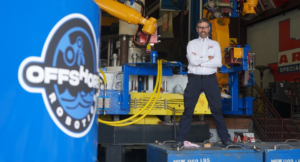
I asked Allford to sum up Houston’s opportunity. Is there a more qualified person to ask?
“You couldn’t design a better city for manufacturing,” he says. We have a good workforce – and a lot of smart people coming out of the colleges here. We have good weather. We have seaports, airports, and trucking. And we have a business-friendly environment.”
Allford comes back to his true north. “I combine all that with, well, I’m a chauvinist towards the oilfield. In the oilfield, we’re solving problems that are just immense. For example, the oil that they’re finding now is so deep, the pressures and temperatures are so high that we literally don’t have the materials and technologies to solve it. So every one of these wells is like a moonshot, where we have to come up with combinations of materials like my overlay systems,” he smiles.
“And so that attitude of solving very, very difficult problems applies to all these new fields – like data centers!” Yet another opportunity. “Nvidia, yeah, they’re going to sell the chips. But guess what, in addition to the chips, you need all the infrastructure that supports them. And that involves welding, fabrication, all the dirty stuff. We’ll take the dirty work, they can make the chips, we’ll all be okay.
“I love it.”
So does Houston.
Bart Taylor is executive director of the Greater Houston Manufacturers Association. Reach him at [email protected].

AI agents and more: How tech DNA powers Piping Technology & Products
/in General/by Bart TaylorCEO Rakesh Agrawal is equal parts technologist and industrialist — and having a blast leading 700 employees at Houston’s stalwart manufacturer
By Bart Taylor
Rakesh Agrawal leads the company his father founded in the mid-1970’s, “growing up in the business on my dad’s knee,” he told me in a recent conversation.
Rakesh’s dad, Dr. Durga Agrawal, parlayed an interest in designing piping systems to a side hustle while earning a PhD at the University of Houston, becoming a self-taught expert in pipe stress analysis. “He’d go out to Shell Deer Park and other chemical plants along the ship channel and, well, help them solve piping problems,” Agrawal says. “People started asking for more. ‘You’re recommending we put these pipe supports or expansion joints into the piping system. Would you supply those to us?’” he recounts with a smile. “So we eventually started our own manufacturing.”
Good thing for Houston. Today the company boasts a workforce of over 700 employees, 400-plus in manufacturing, in 500,000 square feet of covered shop space with 75,000 more on the way as part of a major expansion. The company is building on its 40-acre site at the junction of Highways 288 and 610 – notable by a colorful GONZO247 mural that drivers see every day.
But it’s also the talent mix at PT&P that’s noteworthy – shaped by its tech DNA. “Everything is engineered to order, built to order,” Agrawal says. “We do what could be called ‘mass customization’, where we make a quantity of product, but all different based on the customer’s application. So half of the work we do is engineering, and the other half we do is manufacturing,” he explains. “We’re a mix of knowledge workers – programmers, engineers, buyers and more – and craftspeople – welders and technicians that operate various CNC machines or forklifts.”
It’s a symphony of talent focused on designing and manufacturing products to solve piping system challenges like thermal expansion and contraction, vibration control, and energy containment, in a mass customization model.
The markets PT&P serves are self-evident – but changing, something that we write about every month, it seems. “I think there was a time when oil and gas was 70 or 80% of our business, but we’ve always been diversified. It’s how we survived the crash in oil and gas in the ‘80s while many did not,” he says. “In the last few years, we’ve expanded to selling to mechanical contractors as we do a great deal more work in data centers, pharmaceuticals, and automotive. Data centers, in particular, are a big driver in our business right now.” (For Agrawal and other Houston manufacturers, as we’ve reported.)
The PT&P story today is about what they make and how they’re doing it — and how the company is navigating a technology journey that for many, can be a challenge. PT&P is a manufacturer — and also a tech lab, including the use of AI agents.
I asked where it began. “It started 30-plus years ago. I studied mechanical engineering and computer science, and got two degrees at Rice University. Mechanical engineering is where I grew up, right?, the son of an engineer. When we had a flat tire, it was like, ‘oh, we’re gonna do a soap and bubble test on the tube’,” he laughs. So I grew up around the practice of mechanical engineering, and computers were my hobby, and I was very lucky to have parents who indulged my curiosity in computers. There was always a new computer at the house,” Agrawal says.
“And even at the business, we were always employing technology. I had just finished college, and my first job was building the company’s software systems. We’re in a business where traditional ERP doesn’t really suit us very well because of the mass customization thing I mentioned. ERP likes it when you’re making the same thing over and over again – for example, if you’re making a million AirPods and they’re all only slightly different from one another,” he says. “But in our business you lose your mind trying to use a traditional ERP. So I hired a few friends from Rice, and we built a custom ERP from scratch – and it became the technology core of the company.”
Agrawal actually left the company for a time to scratch his technology itch. “I started a software company, SnapStream, and, as an investor, I built a portfolio of software. SnapStream enables media companies like New York Times, the Daily Show and Colbert, before they went off the air, to source all their short video clips,” he says.
But I had called Agrawal to chat about an AI case study I’d read — at Tasklet that featured PT&P — where his team is using AI agents to enhance productivity. “I started a group within the company two years ago to attempt to drive broader usage of AI at the company. We paid for people’s ChatGPT accounts, and there were good ideas and people were inspired by one another. But it kind of ‘hit a wall’ in terms of broader usage,” he says.
“Then I was introduced to this AI agent technology, Tasklet, through a venture fund I’m an investor in – and they had automated their entire backoffice using it,” Agrawal says.
AI agents abound. Tasklet says its “AI command center…takes ownership of work: it sends emails, updates spreadsheets, files tickets, builds apps, and runs recurring processes across your tools. Describe the outcome in plain English, and Tasklet figures out the rest.” In other words, give your agent the keys to your productivity or process apps, and it organizes your world and improves the processes and tasks in front of you. Its use cases span the operational spectrum of any business, it seems, including shop-floor employees at PT&P.
For his part, Agrawal uses a personal “Chief of Staff” agent connected to 22 services — Gmail, Google Analytics, Google Chat, calendars, and others.
It’s a leap of faith I haven’t yet taken. Agrawal can relate, to a degree. “People have old information,” he says. “They read a headline where OpenClaw came out earlier this year and it drained someone’s bank account. The fact is that these agents have guardrails on them. Sure, they can make mistakes — but generally the mistakes are pretty bounded.”
His employees provide much-needed context. “One of the people on my team — shoutout to Fiona — calls these AI agents ‘genius math babies’,” he laughs. “There’s this weird dynamic where AI is really good at just, like, ridiculously hard things, but then really dumb when it comes to really easy things. Genius math babies. We need to learn how to use them to get work done accurately, to be effective but not drain our bank accounts!”
For Agrawal, his people also provide the ‘true north’ for his company’s tech roadmap. “I kind of think about AI agents as a new productivity primitive. It’s like a spreadsheet or a word processor, and I want us to hurry up and learn how to use word processors and spreadsheets so we can all be more productive.”
Agrawal also acknowledges that the technology he’s harnessing may profoundly impact his workforce – every workforce. I get around to asking what impact this technology will have on jobs. “The job’s question is a hot topic when you talk to people in the AI world. Nobel Prize-winning laureates are apart on the issue,” he says.
“My personal view is that, yes, at some point it’s going to be pretty bad and weird, at least before it gets better. And I see it as my job as the CEO of this company to prepare our workforce and our company for whatever’s next, that next level where new jobs will be created — and get in front of it.”
Read PT&P’s Tasklet use-case study here. We’ll also circle back with Rakesh Agrawal and Houston’s powerhouse manufacturer in later editions. There’s a lot more.
Bart Taylor is president of the Greater Houston Manufacturers Association. Reach him at [email protected].
Inside Texas Injection Molding’s rollup strategy: ‘a good time for buyers and sellers’
/in General/by Bart TaylorJeff Applegate and team have built Houston-based Texas Injection Molding into a regional industrial powerhouse, along the way co-founding the Greater Houston Manufacturers Association in 2013. Recently, Applegate steered TIM into an acquisition by Blackford Capital, where he now leads a rollup strategy to “build a platform of injection molding companies in high-growth regions and high-growth industries.”
There’s good reason for optimism. “June will be our best month ever,” Applegate tells me.
As with other Houston manufacturers, TIM is tapping into sector diversification in the Gulf. “Oil and gas is about 30% of our revenues, and it’s ‘steady to up’. Medical is pretty steady for us, and we’ve had a little spike in some HVAC work, maybe just an anomaly with a customer. But nonetheless, we’ve seen a nice uptick in some of our HVAC markets,” adding, “the construction market right now is good. So we’re doing a lot for home building, apartment building, a lot of ventilation as I mentioned, and building components. The consumer market is also fairly steady.”
Steady is one word. Opportunistic is another. And the manufacturing consortium that Applegate envisions seems well-positioned to tap growing demand across multiple industries.
“The goal is to build a platform of injection molding companies in high-growth regions and high-growth industries. And so much of that is going to be in the southeast and southwest United States. You see that in energy, in medical, in data centers and even automotive in the southeast,” Applegate says.
All good, with the obvious qualifiers: how’s the market for injection molders? And are company owners in a mood to sell?
“We’re a buyer in the market now, and I think it’s a pretty good time to be a buyer. That said, I think the sellers also feel good. In some cases they might be willing to take a little bit less – maybe trying to get out while the getting is good, not hold their hands too long and then find out that the economy doesn’t hold together like they hoped or thought it would,” Applegate says. “You don’t want to sell in down year; somebody once told me, ‘nobody wants to catch a falling star.’ But a company’s trailing 12 months is how many of the companies we’re talking to value their business, and most people’s trailing 12 months is pretty solid.”
Yet distractions continue to weigh on the economy, and I ask if uncertainty is working to keep valuations suppressed. “It may be one of those times where it’s both a good time to be a buyer and a good time to be a seller,” he responded.
The same might be said for the universe of available companies: certainly not lacking, but not overly flush. Meaning a lot of money continues to pursue limited opportunities. “I’ve visited lots of companies all over the southeast – and many in the west. We don’t want to be in California, necessarily; we’d prefer the Phoenix area and then sell into the California market. Today, there are a number of opportunities in California, but not in Phoenix. And the businesses may not be able to move,” he says. “Our business is pretty regionally focused — regional proximity to customers is important. Our customer relationships are important.”
I mentioned recent data from the Dallas Federal Reserve Bank (more detail here) that pointed to an uptick in sentiment, a slowdown in industrial output but gains in wages and productivity. Applegate tracks: he’s optimistic, but cautious about what’s ahead. “If there’s anything, I think it’s what you see across the whole economy. The future is so unpredictable. You know, you could have a crisis that nobody can really predict that can affect the whole economy. And we’re seeing that our customers are not willing, in many cases, to make commitments too far out.”
Applegate’s growing customer base should provide insights into how the market evolves. We’ll circle back in later editions.
Bart Taylor is president of the Greater Houston Manufacturers Association. Reach him at [email protected].
Manufacturing Extension Partnership (MEP) Chaos: How Texas and Houston are Impacted
/in General/by Bart TaylorMuch has been reported recently on the state of the Department of Commerce’s NIST Manufacturing Extension Partnership program, or MEP. The program has been around since 1988, enacted to help small- and medium-sized U.S. manufacturers improve competitiveness, in a nutshell.
It’s a worthy goal that’s led the efforts of all 50 MEP centers – one per state – including the Texas MEP, TMAC, or Texas Manufacturing Assistance Center. Centers receive federal dollars to offset expenses incurred to support manufacturers.
Yet a blistering report released late in 2024 from Commerce’s own auditor provided critics the opening they were looking for to kill the program – led by the Trump administration, who tried to defund the program in 2016 and today, has doubled down on efforts to scrub the budget of any MEP funding.
Those efforts have been thwarted by powerful friends and allies, including governors, congressional delegations, and corporate influencers. Funds have been clawed back. But it’s short-term funding; today the program is on life-support.
Centers aren’t waiting around for the final ax to fall. In Massachusetts, the MEP is transitioning to a trade association model. The California MEP, long a network stalwart, simply morphed into a service provider. Every Center is assessing a path forward.
For its part, TMAC is staying the course. I asked Rodney Reddic, TMAC’s Executive Director, about the Center’s future. “We have strong support from both Democrat and Republican representation across the nation, and we feel that the funding will be restored with the help of ASMC,” he wrote to me. The American Small Manufacturers Coalition (ASMC) is MEP’s Washington D.C.-based lobbyist. Reddic added, “This has happened on several occasions in the past, but we always get the funding restored.”
But truth be told, there’s no shortage of MEP critics.
I’ve worked with multiple MEPs over the years – including TMAC. It’s been a stellar program, led by good people. Thousands of companies have benefitted. But if the MEP network survives, I think Houston manufacturers would benefit from key reforms.
Spread the wealth. In Texas, your perspective on TMAC may depend on where your business is located. Support varies widely. TMAC spreads its federally-subsidized resources and services via a network of so-called “sub-recipients” – or regional nodes. In Greater Houston, UH is the new sub-recipient. TMAC and UH have work to do to be a true market-wide influencer here, in Texas’ largest manufacturing ecosystem.
Others:
Re-brand the MEP and align it with established, pro-manufacturing agencies. The name is clunky and truly, a vestige of the last century. Before changing the brand, find a home in the Federal bureaucracy aligned with its core mission: advancing US manufacturing. There are lots of potential landing spots, including the SBA, which has been a rumored destination.
Reformulate the desired outcomes of MEPs work. Trump’s team may be overly critical, but the current toolkit that many MEPs carry to market is indeed dated. Plus, many MEP Centers are no more than pass-through entities to sell consulting services. Subsidized by tax dollars. Which is fine, unless the Centers are competing with other service providers, which they are. Or if in excluding any vendor from their toolkit, expertise is lost in the process. Which it is.
Change the way Centers are evaluated. MEPs are evaluated from “surveys” of customers meant to gauge the economic impact of services provided. It sounds great. But the process tends to lead MEPs to sell services it favors or can more easily measure. And collecting the data is a slog. Confirming its veracity is, well, difficult. Reimage the KPIs!
Even if the Trump administration wins, and the MEP network loses, something new will take its place. Manufacturing Centers of Excellence should be a national priority. Arm it with the tools needed to help Houston and Texas manufacturers compete.
We’ll report on how other MEPs are adapting or evolving in the weeks ahead.
Bart Taylor is executive director of the Greater Houston Manufacturers Association and founder of Inside MFG. Reach him at [email protected].
Renaissance Man: Dan Allford and ARC Specialties leads Houston manufacturing out of the oilfield and into the future
/in General/by Bart TaylorTo know Dan Allford is to understand that if one person could personify Houston manufacturing, it’s him. Not that he would agree; too modest from too many years in the patch, for one.
But much like Houston, Allford and his company, ARC Specialties, is keeping one foot planted in the oilfield but the other in a new industry mix that includes “nuclear power, additive, defense, data centers, drill-ship automation, and others” as he told me recently. To any manufacturing industry where automation and robotics are involved, where the engineered industrial solutions his team manufactures are already in high demand.
Allford found manufacturing early, or it found him. “Both my parents taught at the University of Texas. My mom was a geneticist, and my father was an English professor. But when I was a kid, I built a steam engine, we built a computer terminal (which taught us how to program), a rocket engine – we had gasoline everywhere so we built a flamethrower – but nobody said ‘kid you’re an engineer.’ Instead, I looked at my parents and said, ‘well, if I’m not an English professor, I must be a geneticist,” he laughs. “I did finally spend a year in the biology department – and then I figured out that people will actually pay you to do the stuff I wanted to do.”
From there, Allford got busy. “I got an Associates Degree in welding from Texas State Technical College in Waco, then got a great job at Hughes Tool Company. The engineers there couldn’t program, so even though I was a technician, I wrote programs for the engineers. It was welding-plus-programming – pretty unique,” Allford recounts. “So Hughes put me through college – I got a Bachelor’s Degree from the University of Houston. But they didn’t have a place for me given the value of my credentials, so I started a little company called ARC Specialties.”
That was 1983. “My first job, this is crazy, was a hot tap at the plutonium plant in Idaho. As far as I know, there’s only one plutonium plant (in the US) and there’s a smokestack that’s a couple hundred feet tall. It’s 316 stainless (steel). It’s eight feet in diameter. It’s three-eighths inches thick, covered with four feet of concrete. And they wanted to bore a hole through the concrete from the outside and slide a pipe in,” he says, almost giddy in describing the project. “The welded pipe was a 10-inch pipe to the smokestack and you couldn’t weld the outside with all this concrete in the way. And so we welded the inside and then plasma-cut the wall out. They said, ‘don’t drop that slug because the machine at the bottom is still running!’ And so we had to hold the slug. But how do you hold stainless?”, he asks. “Can’t use a magnet. We used suction cup!
“So I built that machine back in ‘83 and it worked. If the government had known it was a kid in his garage, they might not have reacted well,” Allford smiles. “But nobody told them – and for us, we’re off to the races.”
After plutonium, I mentioned that a pivot to oil and gas was probably inevitable. “Well, yeah, just by proximity,” Allford responded. “And these are my people, right? These are folks I know. I’m in Houston, and Houston, particularly back in the ‘80s, was almost entirely oilfield.”
Like others, Allford knew what he was getting into. “I love the oilfield. It is great when it’s good and horrible when it’s bad. It’s an extremely cyclical industry. Oil’s at $100 a barrel. So that’s the good news and the bad news. This will create all sorts of chaos,” he mused. “And so I think I’m not the only one in the oilfield that recognized the fact we needed some diversity here in Houston. And so what I started to do was look for opportunities where we could take the technology that we developed here and apply it elsewhere,” he says.
Across industries, there are plenty of examples. “In the electric vehicle industry, they went from spot-welded sheet metal chassis to cast chassis. Well, when you make a casting, you have to trim it, and castings aren’t perfect; you have to trim off the risers, the sprues, the biscuit — and the technology we developed for plasma-cutting three dimensional parts in the oil field was perfectly suited for the EV industry,” he says. “But we needed somebody that would transition that industry from spot-welding to casting in order for us to use that technology. It was like serendipity, fortunately. We came together with the opportunity at the right time.”
That said, Allford and ARC are creating their own opportunities and none more pronounced than the integrated robotic solutions his team is developing — in multiple industries. I asked about ARC’s robotics timeline, when it got started.
“Well, my definition of a robot is programmable, multi-axis, and autonomous. I get a lot of push back on that, but by my definition, there’s a lot (of implementations) that are not robots; they’re tele-operated,” he says.
“Back in the ‘80’s, when ARC Specialties was still ‘part-time’, I worked as a robot integrator, and in the robot industry, there’s something that separates the robot manufacturer from the end-user, and that’s an integrator. The end-user could integrate their own robot. On occasion, the robot companies take that on themselves, but that’s what they call the ‘last mile’ – the toughest part in robotics. Robots are a commodity. People have applications for them, but you have to tool them up and write the software.” he explains.
And Allford touched them all. “Back then, we had a lot of American robot companies. I was using Adept (Omron). I was using Cincinnati Milacron, as well as FANUC, and Daewoo. So that was all happening between ‘83 when I started the company and ‘90 when I decided to go full-time,” he says. “So I’ve been doing robots all the time, and it was a natural progression once I started ARC Specialties.”
Today, ARC’s robotics business seems to be the right solution, at the right time. Allford gets it. As he laughed to me, “in my twilight years, it’s good that it’s kind of coming together.” His client list takes him back to the oilfield, to offshore rigs in the Gulf, to a Naval contract involving submarines — and to industry opportunities poised to change Houston manufacturing. I asked about nuclear energy.
“Well, the nukes are fun, and I’ve been a big fan of nuclear power my whole life. I came close to going to work constructing nuclear power plants when I got out of school in ‘79. I’m glad I didn’t because the industry died for, you know, 30 years, but it’s back and it’s back with a vengeance,” he says. “There are currently 60 companies developing small, modular nuclear reactors right now. And these guys are scary smart when it comes to nuclear physics and such, but they lack two things. They don’t have the ability to do remote manipulation. And unless you want to send your kids into a radioactive zone, we need to send my robots.
“And the second thing they need is welding technology because you have to weld this stuff up.”
Feels like full circle for Allford and ARC. And again, he’s smart enough to know what he doesn’t know. “What I found is that I couldn’t even communicate with these guys; they’re so smart and specialized. So I actually joined the American Nuclear Society, and I took a week-long class. I’m now a certified nuclear guy! With a certificate on the wall. I had to just have the right vocabulary to talk to these folks. But it’s been fascinating and it’s exciting work because it’s dynamic, it’s well funded, and it’s absolutely essential.”
I asked Allford to sum up Houston’s opportunity. Is there a more qualified person to ask?
“You couldn’t design a better city for manufacturing,” he says. We have a good workforce – and a lot of smart people coming out of the colleges here. We have good weather. We have seaports, airports, and trucking. And we have a business-friendly environment.”
Allford comes back to his true north. “I combine all that with, well, I’m a chauvinist towards the oilfield. In the oilfield, we’re solving problems that are just immense. For example, the oil that they’re finding now is so deep, the pressures and temperatures are so high that we literally don’t have the materials and technologies to solve it. So every one of these wells is like a moonshot, where we have to come up with combinations of materials like my overlay systems,” he smiles.
“And so that attitude of solving very, very difficult problems applies to all these new fields – like data centers!” Yet another opportunity. “Nvidia, yeah, they’re going to sell the chips. But guess what, in addition to the chips, you need all the infrastructure that supports them. And that involves welding, fabrication, all the dirty stuff. We’ll take the dirty work, they can make the chips, we’ll all be okay.
“I love it.”
So does Houston.
Bart Taylor is executive director of the Greater Houston Manufacturers Association. Reach him at [email protected].
‘Let’s Make it Here’: Why oilfield icon NOV is rallying in support of US manufacturers
/in General/by Bart TaylorAshe Menon sold his company to NOV (formerly National Oilwell Varco) in 2006 after his firm proved its mettle using mobile devices to help increase uptime on drilling rigs. He stayed on and took a new role in 2015 when NOV and others faced the largest oil and gas downturn in decades. Menon was asked to join Grant Prideco, a subsidiary of NOV, to rightsize the business to meet the new norm in the oil and gas industry.
“Things got hard,” Menon recalls. “We’d already right-sized the oilfield, and so when I joined the company, the question was, ‘how are we going to make money’? We had manufacturing in the US, China, Abu Dhabi, Singapore, and were very vertically integrated with steel coming from Austria.” Faced with downsizing a global business, Menon had no choice but to look at things differently. “We’d already done significant cost reductions in labor, so we asked, ‘let’s see if we can bring this work back to Texas?’ The hypothesis was that there was enough waste in the manufacturing process – we call it ‘invisible loss time’– that if we consolidated production in Texas, we could take the slack out of the system and start making money even in a challenging market. And so we did it.”
Looking back, the results have become a case study in downsizing – an outcome that wasn’t at all certain then. “When you’re doing this in 2015, when you’re faced with something that’s so dark and unclear going forward, you know, you hope you get it right,” Menon says.
“What happened was that the revenue side of the business went from over a billion down to $200-something million in three years. But the cost line was dropping faster than the revenue, so every single time we would beat the profitability goals by thirty and forty percent and sometimes double,” he recounts. “So when we did that three years in a row we felt like this was not a flash in the pan. You didn’t get lucky. You don’t do it three years in a row in the worst downturn in the history of the industry. We were at, ‘we think we know what we’re doing here and we have a process and a plan that we think we can scale and deploy across the company.'”
So what did Menon and this team do?
“The first thing we did was connect all the equipment. We have a trademark now for ‘IoROT’ (a play on IoT) – meaning ‘the Internet of Really Old Things’. If you look at manufacturing in the US, we have lots of old equipment. And to go spend CapEx money on buying a new machine or a new lathe or anything you wanted to buy, you have to make money first. So if you can’t figure out how to make money with old equipment, then just going out and saying new equipment is going to solve the problem is not really the answer,” he says, something that resonates with every manufacturer, large or small.
Menon continues. “So every person (in the plant) was tasked with one thing: how do we get better? How do we figure out how to make money? And we leaned in: We told our employees, ‘if you can come up with ideas to reduce cost, we’ll pay you up to $5,000.’ And the ideas started coming — because the best ideas come from the people doing the work every day — many related to ‘making my really old equipment better,’” he says.
“We also focused on breaking down silos so that it wasn’t maintenances’ problem, or operations, or quality or engineering, when they weren’t in the room. We said, ‘let’s make it all of our problem’. This turned out to be a quick way for us to identify that ‘invisible lost time’. So much so that we now call it ‘invisible lost money’”, Menon laughs.
But back to making really old equipment better. “We instrumented all of these old assets with something very fundamental, right? Whenever we think about sensors, people start getting into vibration and acoustics and things like that. What we said was, ‘no, I just want to know if it’s running.’ So we bought something that you can buy at any hardware shop, we put it onto our assets and said, ‘let’s see if it can tell us if that equipment’s running.’ We put a little smarts into to the data to let us know if the machines were really running (under load) or just spinning. And when that equipment stopped running, it’s like any small machine shop guy knows when that machine is not running, I’m not making money. We did the same thing, except when it’s in a big plant, we connected all of this stuff,” he said.
The platform the team developed to track and report factory-wide performance is now called Auredia. And NOV is not only using the Auredia software and technology platform to monitor its internal machines – over 1100 in total – it’s inviting any manufacturer to join the network, to begin monitoring uptime and other metrics, whether NOV sources from those companies or not.
“When we demonstrated that we could increase profitability, even as revenues suffered, and did it three years in a row in the worst downturn in decades, we knew it wasn’t a flash in the pan,” Menon reiterated. “When it was clear we could scale and deploy the system across any network, Clay Williams, our CEO at the time, asked how we could bottle this up and sell it.” Fast forward to today, and NOV’s Auredia is elbowing into traditional software-service markets like ERP — and more, competing with supplier-sourcing platforms that promise visibility, but lack meaningful operational value out of the gate.
“If you’re a manufacturer, one of the things you will struggle with is that either you’re priced out of certain ERP systems that provide a lot of value, or you’re left hanging with systems that just don’t give you a lot, right? It’s hard to get a perfect fit with an ERP system,” Menon said. It’s in fact a lousy trade-off that bedevils so many small companies.
I asked Menon about the investment a company needs to make in basic IoT before joining?
“Zero,” he answered. “In our onboarding process we ask about make and model, and if we can’t connect out of the gate, we’ll come walk your shop and within the first two hours of determining your equipment set-up, we’ll have a good idea of what it’s going to take for is to connect those machines – including a wireless option we’ve just developed.” And recurring, SaaS-related costs? “If you sign up for three years, there’s no upfront costs, and we charge our customers $100 per month, per machine. If you find value in the platform, we don’t want cost to be the barrier.”
But let’s be real. Why trust NOV, or anyone for that matter, by connecting your machines to a network beyond the safety and security of your own firewall? Menon perked up when I asked.
“First, when we started this, we wanted to be very cognizant of the community of machine shops in Houston, as in, can what we’re developing actually work to bring the community together to solve common problems as we make each of us better? I mean, I know we all worry about IP theft and loss – but every single piece of data we have on the system is stored in blockchain; there’s traceability of who owns what, at all times,” Menon explained.
“But if I’m sourcing a supplier, I’d rather be working with a trusted machine shop that lives in this ecosystem where I can say, ‘let me send you this work.’ And if I have a collection of machine shops, I’m part of the community we live in, that NOV lives in. Can you imagine the amount of time savings I would have if it’s an extension of my own manufacturing when a supplier is on the same network?”
In addition to developing a separate brand, Menon’s team has trademarked the term ‘Let’s Make it Here’, to rally companies to a new, domestic community of manufacturers they envision.
I’ve seen the Auredia dashboard and the real-time monitoring of connected machines – as any machine shop that evaluates the system, would. The benefits are self-evident. Would joining the NOV network also increase your chances of landing NOV business, or other OEMs that begin to tap into this connected-community? It’s early, and hard to say.
But what’s also evident is that the promises made by any number of solution providers give way here to a platform that provides useful intelligence out of the gate, in ways that should resonate with shops hungry for a tech pathway.
Bart Taylor is executive director of the Greater Houston Manufacturing Assocation. Reach him at [email protected].
Why OEMs and product manufacturers should rethink procurement
/in General/by Bart TaylorThere’s excess production capacity in America’s industrial base. Yet finding capable local suppliers is an opportunity that continues to be overlooked
US manufacturing is stuck in a negative feedback loop. Consider Ford CEO Jim Farley’s otherwise well-intentioned comments relating to his company’s workforce challenges. “We are in trouble in our country,” Farley recently said, referring to America’s acute need for trade talent. “We are not talking about this enough.”
Yet for the past decade, talking about manufacturing’s labor shortage is all we’ve done. What we seem incapable of doing is escaping the narrative. So much so that today, opportunities for OEMs and product manufacturers to source more local and domestic manufacturing are going by the wayside. Despite workforce challenges, there’s often ample resources available to manufacture more in the US.
J.B. Cheatham leads Conroe, Texas-based standout Minco CNC. I asked Cheatham recently if his shop had production capacity that could be utilized with current staff.
“Yes, we have available capacity that could be utilized,” Cheatham responded. “Our bottleneck analysis shows that while we have constraints in specific areas (like material availability and certain machining operations), we are not running at full capacity across the board.” He added, “The key qualifier is ‘the right customer’, meaning work that fits precision machining/welding capabilities in segments such as oil & gas subsea components and other engineered like-minded segments, where we can leverage our established quality systems and technical expertise.”
Cheatham acknowledged a perception gap. “The industry talks about talent shortages, but the real issue is more nuanced. Shops like Minco have capacity but can’t just absorb any work – there’s a matching problem between available capacity and work that fits capabilities and our economic model. The ‘talent shortage’ narrative sometimes obscures the fact that many shops have underutilized capacity for the right projects.”
It’s a key insight – the “right project.” But considering that no two manufacturers are alike, each with unique capabilities and talent, the possibility of finding the “right fit” within established industry supply chains, seems high.
Two things seem to be standing in the way.
For one, procurement managers often gloss over “fit” to start with price and lead-time. More deals pivot on “lowest cost, shortest lead-time” than not. It’s a practice that vexes the manufacturers that OEMs and product manufacturers rely on.
I interviewed Daniel Hester, CEO of Austin-based American Precision Engineering in 2024, and his comments have stuck with me since. Hester’s APE had won an opportunity on what he described as a “wheelhouse” project. “In the end, it was solving a very complex geometry problem — how can we figure out how to get all this functionality into a very small space from what essentially began as a crayon drawing? To be trusted with that process means everything,” he said at the time.
“Consider the alternative,” Hester added. “What we often see is that a customer will design something, give it to us and basically say, ‘how much to make this?’ The cost is often astronomical — and we tell them why. They go back to the drawing board, and they bring something back again. But it’s the same price for a different reason,” he laughed. “They quite often end up throwing that part ‘over the fence’ (to offshore providers) to shop on price, when the better approach would be to hire a design-to-manufacturer like us. We’re involved from the outset, but then share in the rewards of the value we’re created,” Hester explains. “And when I talk to companies that are like, ‘oh, we send this stuff overseas,’ I’m just like, ‘how do you sleep at night? You’re literally slitting your own throat.’”
I wrote then that “This self-defeating behavior, where companies wish there were more capable domestic manufacturing options, only to perpetuate offshore supply chains, is maddening — but also a habit that’s hard to break.”
The other “bottleneck” to procurement reform is, well, us. Manufacturers are notoriously tight with information. If we want a more transparent, accessible ecosystem, it’s up to us to make it so.
There’s no shortage of good ideas to help OEMs and product manufacturers source new providers. In fact millions are being invested in digital platforms that would match demand for domestic manufacturing with supply – platforms like Sustainment, CONNEX Marketplace, MFG.com, Thomas, and others. In food and beverage, similar efforts have taken root, including PartnerSlate and Keychain.
Perhaps a sleeper in the group is a production platform developed by Houston-based, energy manufacturer NOV. I’ll detail their efforts in a follow up column.
Ironically, what’s lacking in this dizzying array is the very thing suppliers value: insight relating to “fit.” Finding people and culture and expertise that often make or break a deal – some of the “nuance” that Cheatham mentioned – is often hard for buyers to glean from data
None of this is easy. But influencers throughout manufacturing’s value-chain have been working tirelessly to raise awareness, revise school curricula, innovate with apprenticeships and the like, and altogether engage industry to train and deploy more talent. It’s been an epic undertaking, and for some of us, it’s evident that we’re turning a corner on the workforce challenge.
Until we change the narrative and embrace the possibilities of what can be done, and not what’s lacking, the outcome all of us seek will continue to be elusive.
Bart Taylor is executive director of the Greater Houston Manufacturing Association and founder of InsideMFG. Reach him at [email protected].
Why manufacturing’s AI-lag is a good thing
/in General/by Bart TaylorIt’s no secret that across US industry, adoption rates of AI, and technology in general, differ. Consider service giant Amazon. Insiders now forecast the company to jettison 500,000 employees in the coming years because of AI, on top of tens of thousands already sent packing.
Manufacturers have no such luxury – or inclination. People are gold. And if manufacturers lag behind their service counterparts in deploying AI, there’s often a good reason, namely the big difference between moving a product and making one.
But with so much buzz attending to AI, it’s understandable if companies are nervous. With so many stories of cost savings and enhanced profitability floating about, it’s easy to worry about being left behind in the AI scramble.
Art Casasa is a Houston-based Senior Engineering and Program Management Executive who helps organizations bridge the gap between traditional manufacturing and the future of intelligent, data-driven production. He told me manufacturers shouldn’t lose sleep over being left behind. Yet.
“It’s not a bad thing that manufacturing is not adopting at the same rate (compared to services),” Casasa said, “because if they were, they’d be failing. A recent study at MIT indicates that 95% of implementations of AI fail – completely fail. So you only see like five to 10% good implementations,” he says.
That’s not to say that more could be succeeding, with a different approach. “What’s happening right now is companies want to put a layer-like cake of AI on top of their systems. ‘Oh, let’s do AI here and there and there and here.’ And let’s grab all the ideas from the workforce on where they or we should put AI.’ However, they’re not looking at the value proposition,” Casasa says. “And that’s when they fail. And like I said, like 90%-plus are investing too much money in AI. They’re pouring money into AI like crazy. But it’s not proven. And the reason it’s not proven is like they want to do everything – and that’s not possible. It’s like any manufacturing process. It takes time to onboard new processes, including AI,” he says.
Casasa points to another barrier – people. “Often the most difficult part (in succeeding) is onboarding the people that need to use AI.” Call it another irony of the AI revolution.
“Companies want to follow the trend, right, where AI replaces middle management, reduces top management, and companies then move into a state where there’s more self-administration, where there might be one person here or there, aligning the workforce,” he says. “But what I think will happen, is that the workforce will start doing their own administration. And people on the lines, technical people on the lines, like you mentioned – technicians, operators, all of these people – will remain. So anyone that’s working with their hands, if their work cannot be automated, which is many cases, maybe 80% – they’ll stay.”
Yet some employees, in all companies and across industries, are in the crosshairs according to Casasa. “I can build an (AI) application of checking invoices versus purchase orders and find problems in between before they hit the payment cycle. That’s something that a person might take four or five hours a week. Now it’ll be two minutes,” he says. “You’ll start seeing that and you’ll start seeing accounting being reduced because now you can do the full accounting of a company by an agent in AI, that will work better than a CPA. Those are facts. Accounting will be displaced, HR, to a point, that will be displaced, and all the processes within hiring and posting, all of those things can be done with AI,” Casasa says.
“I think what companies need to do, they need to start working on leadership at the lower levels, because I don’t see the middle management surviving in five to ten years.”
I speculated that one interpretation of Casasa’s analysis – one path forward for manufacturers – is to dive into the operational parts of the business where AI can be leveraged now, like backoffice savings, then pour those resources into technology adoption in the production side of the business. Manufacturers still need to fully adopt pre-AI technology, after all, like IoT.
Casasa went along, to a degree. “IoT, like you mentioned, that was 4.0 kind of thing, it should have been implemented to the maximum ability – right now. It’s actually not difficult to implement. The first stage is going to be heavy on cost, but it’ll pay for itself within a two year cycle, maybe even a one year. Implementing IoT, and then dumping all your data into the cloud, is a relatively easy process. It’s just depending on the amount of IoT devices you have, but it’s just scaling the cloud to whatever you have in the ground. It’s actually not difficult to do.”
If you’ve not found it easy, Art Casasa and others – including GHMA contributor Nadeem Azhur – can help. Azhur’s monthly blog is great reading, and Casasa will begin leaning in with a series on AI implementation, in the coming weeks.
For those manufacturers that have kept their powder dry, congrats. But there’s no time to be complacent.
Bart Taylor is executive director of the Greater Houston Manufacturing Association and founder of Inside MFG. Reach him at [email protected].
Contact Art Casasa at [email protected].
Why Cobot Welding is Breaking Through in a Big Way
/in General/by Bart TaylorDoug Rhoda and team launched Vectis Automation at FABTECH in 2019, after deciding a year earlier the timing was probably right. “I walked FABTECH in 2018, asking myself, ‘is this (cobot welding) going to make sense or not?’” Six years later, with over 700 units now installed throughout North America, the answer is evident. But in 2018, there were still doubts.
“I went there to probe, to explore, to answer the question, ‘is there an opportunity here?’ And I actually got a lot of negativity from the veterans in the marketplace. It was like ‘that universal robot thing, that cobot, that’s a toy.’”, recalls Rhoda. “They were more proud of the big industrial robots. And so most of the feedback I got as I probed was negative from the people in the industry.”
Rhoda pushed ahead. “It was kind of the classic innovator’s dilemma where you’ve got the sustaining technologies – make it bigger, faster, whatever – versus the disruptive technology, which is what cobots were,” he says.
But more, as industry veteran Rhoda had a birds-eye view of pain-points in the industry, among them, the difficulty small and medium-size manufacturers have buying and deploying new technologies.
“At Wolf Robotics (Rhoda was a co-founder) we were providing very large, expensive machines. And there was this great pain, production pain, with the shortage of skilled welders. And the small, medium enterprises just could not justify the big, expensive things. The footprint and floor space was large. And you’re sending people to training, which is hard, and then there’s installation crews back and forth, travel expenses, lead times, you know, four to six months,” he says.
“So, we just disrupted all that.”
So much so that today, the category is exploding, driven in part by affordability. Cobot welding has become an attainable, cost-effective means for small manufacturers to get in the automation game.
Still, suppliers like Vectis have to demonstrate that the investment improves a company’s competitiveness, and fits its workforce strategy. I asked Rhoda if Vectis’ success could be attributed more to helping companies manage a shortage of skilled labor, or to improving their operations?
“Well, there’s a shortage of skilled welders for sure,” he answers. “But we chose the name Vectis, for a reason. It’s Latin for “lever”, and the idea that it’s ‘human plus machine.’ In our case, you have your seasoned, experienced welder teach the cobot. And then as it’s running, somebody can be loading, unloading, whatever, and it’s a way to scale three-to-one and make weldments better, faster, safer.”
Quality improvements may be even more important. “Whenever you can automate welding where you control the travel speed, the voltage and wire-feed speed parameters, you get consistent welds with predictable distortion,” he explains. “With manual welding, you’ll sometimes get different distortion. Your end product is different. So there’s all these effects.
“Also, with productivity, the rule of thumb is three-to-one return. We have examples of 10-to-one in cladding – the high-arc time applications. In some cases, people are doing manual TIG welding and going to cobot MIG welding,” Rhoda says. “That’s a huge change in productivity with travel speed and so forth.”
I asked Rhoda what a typical installation looks like for Vectis. “Cobot welding is really attractive for high-mix, low-volume environments, where I’m changing things out. I need something portable. I can move it around my factory.’ So even the traditional users can evaluate different deployment options,” he says.
“And as I mentioned, the small-to-medium size contract fabricators were who we wanted to address from the beginning. That’s still true. But the pleasant surprise has been even the big users of traditional robotic welding have bought cobot welding systems from us because it helps address the high-mix, low-volume type applications where they couldn’t really justify the setup time and putting in large, expensive systems.”
Vectis’ success in cobot welding has led to a new robotic plasma-cutting product line. Early returns, not surprisingly, are strong. “Three-dimensional shapes may still be better-suited to things like tube lasers, especially if you have higher volume. But if you’re currently cutting things by hand three-dimensionally, we can improve that quality – and productivity, significantly,” Rhoda says.
It all adds up to a win-win scenario for cobot welding and cutting suppliers and a target market of small-and-medium shops hungry for automation.
Bart Taylor is executive director of GHMA and founder of Inside MFG. Reach him at baylor.media.com
Contact Doug Rhoda, Chairman and founder of Vectis Automation, at [email protected].
CEO Nubia Perez’s LinkedIn videos are an HR home-run. Will new customers follow?
/in General/by Bart TaylorNubia Perez joined the family business full-time in 2012 and became CEO of Gretna Machine in 2023, a decade to ‘season’ and learn the ins-and-outs of operations. Right? Well, sort of.
“During that time I wasn’t in a business development role, more behind the scenes,” says Perez. “For example, getting us into aerospace, leading the AS9100 certification efforts, and trying to organize the company and creating processes and procedures. That was my role.”
When the time came, Perez approached business development with a few preconceived notions. “I did not have that sales role or development role for a good portion of the years that I was here, but during that time, I remember as a team talking about social media, and Facebook was very popular,” she says. “And our response was always, we’re B2B, so there’s no space for social media in our marketing efforts. We want to be private, under the radar. And that was just what we always thought – what’s the point? We already know we’re not going to be using Facebook on par with our major oil and gas customers.”
But inspiration comes from unexpected sources, at times. “To be honest, it was our 23-year-old receptionist who pushed me for months that I needed to get on social media,” she laughs. “At first I was, like, no, no, no. We are B2B. There’s no space for it. I don’t like social media. I don’t do Facebook. I don’t do any of that stuff. But she kept saying, ‘Nubia, you really need to get on LinkedIn.’”
“So we just started. Our receptionist told me ‘let me just do one video.’ And I was very nervous. I said, ‘well, let me just talk about something. And I think our first videos were just talking about our values.”
The topic comes easy for Perez – and other generational leaders, where core values often sustain the business, year after year. It’s why, in part, they’re successful.
“Turns out it was something that came very natural; I didn’t need a script or anything,” she says. “And once I kind of shook off the nerves, then I just kept doing it a little bit more frequently. And I remember reading about the important role of authenticity in leadership, and that really resonated with me. I knew I just needed to be myself.”
The content was aligned with what Perez had been thinking about for years, like “What type of company are we? What type of values were we founded on 45 years ago?” Perez recounts. “And what are some values that haven’t changed? What is our culture now? Not so much aspirational values, but culture that’s already here? To build on.”
Turns out culture, and values, are what employees and customers care about. And so far, Perez’s LinkedIn videos have become an important HR asset.
“The last couple of hires we’ve had have all been through LinkedIn,” says Perez. “Some of them have reached out to me without us even looking at hires. I started to receive messages asking me, ‘hey, are you looking to hire? Because I’ve seen what you guys are about and I’d love to be a part of that company.’ So it’s made the hiring process actually quite more streamlined because we say ‘you can teach technical, but you can’t teach values and culture.’”
All that said, has Perez’s LinkedIn sojourn resulted in new customers? Are Gretna Machine’s buyers hanging out on LinkedIn? After all, culture and values and people sometimes make or break a deal. Perez wouldn’t offer an unqualified ‘no’; for her, it’s really not the right question to ask, at this point.
“I mean, once we succinctly determine what our top five core values are, and that we’re going to hire, fire, promote, partner – and look for in customers and vendors – with those in mind, then our brand is slowly taking shape around that,” she says. “But, we’re a machine shop that’s highly technical. Having our message evolve to more technical videos – to knowledge transfer” seems to be in the cards.
“For example, lessons around the world of lean manufacturing, of operational waste, of having standard processes and procedures that many family-owned businesses struggle with. Or, especially as a job-shop, if you have 26 different ways of onboarding a customer, then things are going to fall through the cracks. Or if hours before you’re going to ship, you realize, ‘oh, I don’t even know who I’m supposed to send this invoice to once we ship the parts,’ because we didn’t do it in a standard way. These are lessons you learn,” she says, “that we’ve had to go through. After almost 45 years, we’re now in a position to share some of that knowledge.”
Whatever the messaging, Perez hopes one thing comes through on LinkedIn. “In a world of so much noise, in the world of so much of everything, I just want to see real, just real. I don’t know what the opposite of authenticity is – non-authenticity, fakeness, whatever – but what I’m hoping to do is not what other companies are doing.”
LinkedIn has evolved into a “career board”, of sorts. As such, Perez’s HR outcomes aren’t surprising. Today its legion of critics also bemoan the “humblebraggers” and self-promotion that’s replaced content that would otherwise lead to more dealmaking.
But If Perez continues to bring “real”, new customers may follow. As much as LinkedIn earns its diminishing reputation, good content always finds a path to people that matter.
I’ll be watching.
Bart Taylor is executive director of the Greater Houston Manufacturing Association, and publisher of MFGInsider. Reach him at [email protected].
Here’s why OEMs are investing in US manufacturing, and why they’re not
/in General/by Bart TaylorLast month we reviewed Reshoring Initiative’s (RI) 2024 Annual Report that summarized announced plans by US companies to reshore manufacturing jobs.
RI followed up the ‘24 Report with a 2025 survey of US manufacturers “to determine where U.S. manufacturers are with respect to reshoring and the key factors influencing those decisions.” Participation was high: over 500 companies responded.
Read between the lines and the findings also tell us why US companies invest in onshore manufacturing, and why they don’t.
RI wisely divided the survey into two distinct camps: ‘Respondents self-selected as either Original Equipment Manufacturers (OEMs) or Contract Manufacturers (CMs). An OEM is defined as manufacturing end products, often from component parts procured from other organizations. A CM is defined as manufacturing parts, components, and tooling to be used in an OEM end product.’
Highlights from the survey – and comments:
OEM
Contract Manufacturers (CM)
My takeaways:
First, read the entire report. More:
I’ll be interviewing RI founder and president Harry Moser to dig in more, and talk manufacturing impact of the Big Beautiful Bill, in the coming days. Stay tuned.
More soon.
Bart Taylor is founder of InsideMFG and executive director of the GHMA. Reach him at [email protected].