
Renaissance Man: Dan Allford and ARC Specialties leads Houston manufacturing out of the oilfield and into the future
To know Dan Allford is to understand that if one person could personify Houston manufacturing, it’s him. Not that he would agree; too modest from too many years in the patch, for one.
But much like Houston, Allford and his company, ARC Specialties, is keeping one foot planted in the oilfield but the other in a new industry mix that includes “nuclear power, additive, defense, data centers, drill-ship automation, and others” as he told me recently. To any manufacturing industry where automation and robotics are involved, where the engineered industrial solutions his team manufactures are already in high demand.
Allford found manufacturing early, or it found him. “Both my parents taught at the University of Texas. My mom was a geneticist, and my father was an English professor. But when I was a kid, I built a steam engine, we built a computer terminal (which taught us how to program), a rocket engine – we had gasoline everywhere so we built a flamethrower – but nobody said ‘kid you’re an engineer.’ Instead, I looked at my parents and said, ‘well, if I’m not an English professor, I must be a geneticist,” he laughs. “I did finally spend a year in the biology department – and then I figured out that people will actually pay you to do the stuff I wanted to do.”
From there, Allford got busy. “I got an Associates Degree in welding from Texas State Technical College in Waco, then got a great job at Hughes Tool Company. The engineers there couldn’t program, so even though I was a technician, I wrote programs for the engineers. It was welding-plus-programming – pretty unique,” Allford recounts. “So Hughes put me through college – I got a Bachelor’s Degree from the University of Houston. But they didn’t have a place for me given the value of my credentials, so I started a little company called ARC Specialties.”
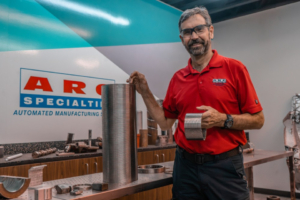
That was 1983. “My first job, this is crazy, was a hot tap at the plutonium plant in Idaho. As far as I know, there’s only one plutonium plant (in the US) and there’s a smokestack that’s a couple hundred feet tall. It’s 316 stainless (steel). It’s eight feet in diameter. It’s three-eighths inches thick, covered with four feet of concrete. And they wanted to bore a hole through the concrete from the outside and slide a pipe in,” he says, almost giddy in describing the project. “The welded pipe was a 10-inch pipe to the smokestack and you couldn’t weld the outside with all this concrete in the way. And so we welded the inside and then plasma-cut the wall out. They said, ‘don’t drop that slug because the machine at the bottom is still running!’ And so we had to hold the slug. But how do you hold stainless?”, he asks. “Can’t use a magnet. We used suction cup!
“So I built that machine back in ‘83 and it worked. If the government had known it was a kid in his garage, they might not have reacted well,” Allford smiles. “But nobody told them – and for us, we’re off to the races.”
After plutonium, I mentioned that a pivot to oil and gas was probably inevitable. “Well, yeah, just by proximity,” Allford responded. “And these are my people, right? These are folks I know. I’m in Houston, and Houston, particularly back in the ‘80s, was almost entirely oilfield.”
Like others, Allford knew what he was getting into. “I love the oilfield. It is great when it’s good and horrible when it’s bad. It’s an extremely cyclical industry. Oil’s at $100 a barrel. So that’s the good news and the bad news. This will create all sorts of chaos,” he mused. “And so I think I’m not the only one in the oilfield that recognized the fact we needed some diversity here in Houston. And so what I started to do was look for opportunities where we could take the technology that we developed here and apply it elsewhere,” he says.
Across industries, there are plenty of examples. “In the electric vehicle industry, they went from spot-welded sheet metal chassis to cast chassis. Well, when you make a casting, you have to trim it, and castings aren’t perfect; you have to trim off the risers, the sprues, the biscuit — and the technology we developed for plasma-cutting three dimensional parts in the oil field was perfectly suited for the EV industry,” he says. “But we needed somebody that would transition that industry from spot-welding to casting in order for us to use that technology. It was like serendipity, fortunately. We came together with the opportunity at the right time.”
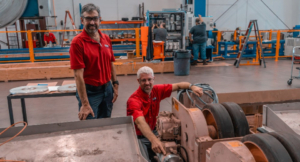
That said, Allford and ARC are creating their own opportunities and none more pronounced than the integrated robotic solutions his team is developing — in multiple industries. I asked about ARC’s robotics timeline, when it got started.
“Well, my definition of a robot is programmable, multi-axis, and autonomous. I get a lot of push back on that, but by my definition, there’s a lot (of implementations) that are not robots; they’re tele-operated,” he says.
“Back in the ‘80’s, when ARC Specialties was still ‘part-time’, I worked as a robot integrator, and in the robot industry, there’s something that separates the robot manufacturer from the end-user, and that’s an integrator. The end-user could integrate their own robot. On occasion, the robot companies take that on themselves, but that’s what they call the ‘last mile’ – the toughest part in robotics. Robots are a commodity. People have applications for them, but you have to tool them up and write the software.” he explains.
And Allford touched them all. “Back then, we had a lot of American robot companies. I was using Adept (Omron). I was using Cincinnati Milacron, as well as FANUC, and Daewoo. So that was all happening between ‘83 when I started the company and ‘90 when I decided to go full-time,” he says. “So I’ve been doing robots all the time, and it was a natural progression once I started ARC Specialties.”
Today, ARC’s robotics business seems to be the right solution, at the right time. Allford gets it. As he laughed to me, “in my twilight years, it’s good that it’s kind of coming together.” His client list takes him back to the oilfield, to offshore rigs in the Gulf, to a Naval contract involving submarines — and to industry opportunities poised to change Houston manufacturing. I asked about nuclear energy.
“Well, the nukes are fun, and I’ve been a big fan of nuclear power my whole life. I came close to going to work constructing nuclear power plants when I got out of school in ‘79. I’m glad I didn’t because the industry died for, you know, 30 years, but it’s back and it’s back with a vengeance,” he says. “There are currently 60 companies developing small, modular nuclear reactors right now. And these guys are scary smart when it comes to nuclear physics and such, but they lack two things. They don’t have the ability to do remote manipulation. And unless you want to send your kids into a radioactive zone, we need to send my robots.
“And the second thing they need is welding technology because you have to weld this stuff up.”
Feels like full circle for Allford and ARC. And again, he’s smart enough to know what he doesn’t know. “What I found is that I couldn’t even communicate with these guys; they’re so smart and specialized. So I actually joined the American Nuclear Society, and I took a week-long class. I’m now a certified nuclear guy! With a certificate on the wall. I had to just have the right vocabulary to talk to these folks. But it’s been fascinating and it’s exciting work because it’s dynamic, it’s well funded, and it’s absolutely essential.”
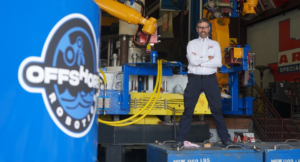
I asked Allford to sum up Houston’s opportunity. Is there a more qualified person to ask?
“You couldn’t design a better city for manufacturing,” he says. We have a good workforce – and a lot of smart people coming out of the colleges here. We have good weather. We have seaports, airports, and trucking. And we have a business-friendly environment.”
Allford comes back to his true north. “I combine all that with, well, I’m a chauvinist towards the oilfield. In the oilfield, we’re solving problems that are just immense. For example, the oil that they’re finding now is so deep, the pressures and temperatures are so high that we literally don’t have the materials and technologies to solve it. So every one of these wells is like a moonshot, where we have to come up with combinations of materials like my overlay systems,” he smiles.
“And so that attitude of solving very, very difficult problems applies to all these new fields – like data centers!” Yet another opportunity. “Nvidia, yeah, they’re going to sell the chips. But guess what, in addition to the chips, you need all the infrastructure that supports them. And that involves welding, fabrication, all the dirty stuff. We’ll take the dirty work, they can make the chips, we’ll all be okay.
“I love it.”
So does Houston.
Bart Taylor is executive director of the Greater Houston Manufacturers Association. Reach him at [email protected].