
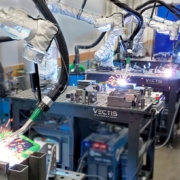
Why Cobot Welding is Breaking Through in a Big Way
Doug Rhoda and team launched Vectis Automation at FABTECH in 2019, after deciding a year earlier the timing was probably right. “I walked FABTECH in 2018, asking myself, ‘is this (cobot welding) going to make sense or not?’” Six years later, with over 700 units now installed throughout North America, the answer is evident. But in 2018, there were still doubts.
“I went there to probe, to explore, to answer the question, ‘is there an opportunity here?’ And I actually got a lot of negativity from the veterans in the marketplace. It was like ‘that universal robot thing, that cobot, that’s a toy.’”, recalls Rhoda. “They were more proud of the big industrial robots. And so most of the feedback I got as I probed was negative from the people in the industry.”
Rhoda pushed ahead. “It was kind of the classic innovator’s dilemma where you’ve got the sustaining technologies – make it bigger, faster, whatever – versus the disruptive technology, which is what cobots were,” he says.
But more, as industry veteran Rhoda had a birds-eye view of pain-points in the industry, among them, the difficulty small and medium-size manufacturers have buying and deploying new technologies.
“At Wolf Robotics (Rhoda was a co-founder) we were providing very large, expensive machines. And there was this great pain, production pain, with the shortage of skilled welders. And the small, medium enterprises just could not justify the big, expensive things. The footprint and floor space was large. And you’re sending people to training, which is hard, and then there’s installation crews back and forth, travel expenses, lead times, you know, four to six months,” he says.
“So, we just disrupted all that.”
So much so that today, the category is exploding, driven in part by affordability. Cobot welding has become an attainable, cost-effective means for small manufacturers to get in the automation game.
Still, suppliers like Vectis have to demonstrate that the investment improves a company’s competitiveness, and fits its workforce strategy. I asked Rhoda if Vectis’ success could be attributed more to helping companies manage a shortage of skilled labor, or to improving their operations?
“Well, there’s a shortage of skilled welders for sure,” he answers. “But we chose the name Vectis, for a reason. It’s Latin for “lever”, and the idea that it’s ‘human plus machine.’ In our case, you have your seasoned, experienced welder teach the cobot. And then as it’s running, somebody can be loading, unloading, whatever, and it’s a way to scale three-to-one and make weldments better, faster, safer.”
Quality improvements may be even more important. “Whenever you can automate welding where you control the travel speed, the voltage and wire-feed speed parameters, you get consistent welds with predictable distortion,” he explains. “With manual welding, you’ll sometimes get different distortion. Your end product is different. So there’s all these effects.
“Also, with productivity, the rule of thumb is three-to-one return. We have examples of 10-to-one in cladding – the high-arc time applications. In some cases, people are doing manual TIG welding and going to cobot MIG welding,” Rhoda says. “That’s a huge change in productivity with travel speed and so forth.”
I asked Rhoda what a typical installation looks like for Vectis. “Cobot welding is really attractive for high-mix, low-volume environments, where I’m changing things out. I need something portable. I can move it around my factory.’ So even the traditional users can evaluate different deployment options,” he says.
“And as I mentioned, the small-to-medium size contract fabricators were who we wanted to address from the beginning. That’s still true. But the pleasant surprise has been even the big users of traditional robotic welding have bought cobot welding systems from us because it helps address the high-mix, low-volume type applications where they couldn’t really justify the setup time and putting in large, expensive systems.”
Vectis’ success in cobot welding has led to a new robotic plasma-cutting product line. Early returns, not surprisingly, are strong. “Three-dimensional shapes may still be better-suited to things like tube lasers, especially if you have higher volume. But if you’re currently cutting things by hand three-dimensionally, we can improve that quality – and productivity, significantly,” Rhoda says.
It all adds up to a win-win scenario for cobot welding and cutting suppliers and a target market of small-and-medium shops hungry for automation.
Bart Taylor is executive director of GHMA and founder of Inside MFG. Reach him at baylor.media.com
Contact Doug Rhoda, Chairman and founder of Vectis Automation, at [email protected].